
by Enrico Baccarini©
http://www.enricobaccarini.com/?p=499
Stigmata are one of the most incredible phenomenon human being have experiencedin their history.
This phenomenology has always attracted interest of both religious and the scientific world. Interpretation of these events, believed to be the transposition of Jesus Christ’s wounds on the cross, has alternated over time of worship to other moments of harsh protest. Stigmata has passed more than eight hundred years of existence, faith, doubts, uncertainties and confirmations. The Roman Catholic Church itself, as in the case of the Holy Shroud of Turin, was nevergiven a final decision in the face of these events, investigating it separately the subjects said that they carry.
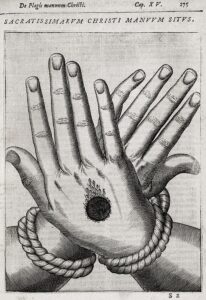
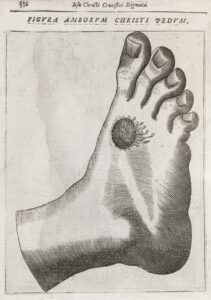
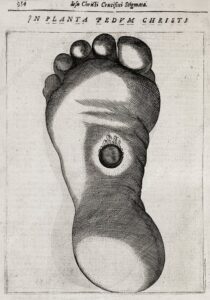
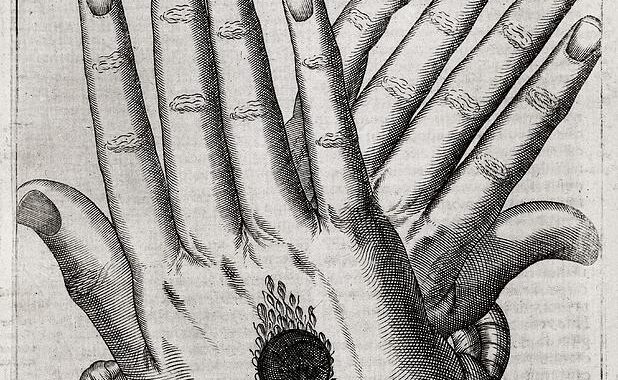
Historia admiranda de Iesu Christi stigmatibus (1607) of the italian bishop Alfonso Paleotti (1531-1610).
In the light of research carried out by the end of the XIX century to date, we can bring more clarity on the possible origins of these signs.
The will, which has always distinguished man, you want tounderstand God and its manifestations, has allowed in more than a century of studies of a new basis for understanding the stigmata.What lies behind this strange phenomena?
The rigorous and systematic manifestations of stigmatic had itsbeginnings in the late nineteenth century when several researchersbegan to examine, on a scientific basis, the genesis of these signs.
In our study we will present to the readers of Archeomisteri the result of over a century of research, and some recent contributionsthat could explain, or perhaps shed more light on these events.
In many subjects these injuries occur during the Easter period,following the custom which is established annually, and this festivalis not really the time when Christ was crucified. In other subjectsthe marks follow a policy of continuity (even lasting the whole of a life), while other cases present us with those “intermittent” as such events are often associated with trance states.
Curiously, the stigmata are not just a prerogative of the Catholic Christian world in particular, but have been reported in recent years, Protestant and Muslim world.
From the thirteenth century the Church has well-documented 400 cases of persons who would receive the gift of the stigmata. Although this phenomenology signs profoundly Christian doctrinestill remain many doubts, not yet explained the genesis of their expression.
From the analysis conducted in the population of persons with thatfrom the thirteenth to the nineteenth century the relationship betweenmen and women, custodians of the stigmata (the 400 documented cases) were seven women for every man, while the estimate falls in the 900s and we are faced with three women for every two men. Remains clear is that since such phenomena began to occur, women have been the major carriers of these signs. It must be veryclear that, in most cases, the subjects carrying belonged to religious orders or groups of devout Christians.
On the evening of Friday, May 4, 1990, Anna Maria T., a 65-year-old widow from Milan, Italy, was saying her prayers in bed when she suddenly felt strong, sharp pains in her forehead, as if it was being pierced by thorns. As the woman later recounted to Marco Margnelli, a neurophysiologist for the Center for Study and Research of States of Consciousness in Milan, she looked around her bedroom, and in a corner was startled to see an apparition of Jesus Christ himself. The figure vanished into a black cloud and then reappeared wearing a thorny crown, at which point Anna Maria’s forehead pain disappeared. The apparition then asked her to put out her hands, and touched them. The next morning, she awoke to discover painful round red marks on her hands. She went to the doctor, who ordered x-rays of her hands and prescribed an ointment that seemed to make the wounds go away. But then, almost exactly a month later, the marks on her hands reappeared, lingered for several days, and then disappeared again just as mysteriously. This time, she went to see a Roman Catholic priest, who told her that God had given her a gift.
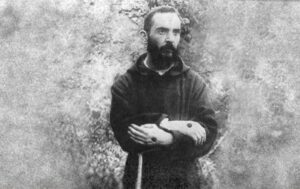
Padre pio of Pietralcina
Anna Maria had become one of probably only a handful of people on the planet afflicted with stigmata — painful wounds that seem to spontaneously appear and disappear, mimicking the injuries suffered by Christ during his torture and crucifixion. Stigmata belong to a long list of supernatural phenomena that fervent religious believers have claimed to experience over the centuries — an otherworldly array that includes weeping statues, apparitions of the Virgin Mary, a vial of dried blood from a 4th Century saint that inexplicably liquefies each year in a Naples church, and the Shroud of Turin, a cloth of mysterious origins which is purported to bear the imprint of Christ’s face and body. A 2004 Fox News poll found that 82 percent of Americans believed in miracles of all kinds — well more than twice the number who believed in UFOs, ghosts or reincarnation.
But among this paranormal panoply it’s the religious phenomena like stigmata that appear to inspire an intense synergy of fascination, awe and fervor. One reason may be that stigmata, while rare, seem to be more common than other miraculous phenomena. Since St. Francis of Assisi experienced the first recorded case of stigmata during a religious vision in 1224, researchers have documented more than 400 other persons with the affliction, and in the past 30 years alone, more than a dozen cases have been reported in locales ranging from South Korea to Argentina. Beyond that, some believers in the phenomenon view stigmatics as a spiritual elite, whom Christ has rewarded for their extreme piety by allowing them to experience his torment. The Italian stigmatic Padre Pio, a Capuchin monk who died in 1968 and was canonized by the Roman Catholic Church in 2002, is so revered that when his body was exhumed and put on display at a shrine in April 2008, approximately 750,000 pilgrims made hotel reservations to visit in the first three months alone. And it doesn’t hurt that doctors, scientists and skeptical debunkers have yet to come up with an airtight medical or scientific explanation for stigmata, try as they might.
“It defies science,” explains psychologist Mario Martinez, who has studied numerous stigmata cases. “And it allows people to have hope. There’s an archetype of suffering to gain redemption, and you can’t get more graphic about suffering than replicating the wounds of Christ.”
Stigmata Symptoms
Over the years, many studies on stigmatics have amassed a considerable amount of data, though it doesn’t necessarily lead to any clear-cut conclusions. St. Francis and Padre Pio notwithstanding, about 90 percent of stigmatics are female. They also tend to be Roman Catholics, though there are notable exceptions, such as the alleged case in the mid-1990s of Amyr Amiden, a Brazilian man of Iranian and Syrian descent, who was raised as a Muslim. Up until the beginning of the 20th Century, cases of stigmata seemed to be confined to Europe, though since then they’ve occurred in a variety of countries.
 Stigmata of St. Francis, Domenico Ghirlandaio (1482-85)
One of the most puzzling aspects of the phenomenon is that its symptoms can vary greatly from case to case. As University of Western Ontario sociologist Michael Carroll noted in his 1989 book Catholic Cults & Devotions: A Psychological Inquiry, while stigmatics generally suffer wounds on their hands or wrists, feet and torso, some develop more extensive Christ-like injuries as well. 19th century French stigmatic Marie-Julie Jahenny exhibited a bruise on her shoulder, as if from carrying a cross, marks on her forehead seemingly caused by a crown of thorns, and stripes on her ankles, legs and forearms as if she had been scourged. Some stigmatics bleed regularly every week from Thursday evening to Friday afternoon, the time in which Christ’s torture and execution took place, while others bleed only on particular religious holidays, or after receiving holy communion.
Skeptics, of course, have long contended that stigmatics fake their injuries. Joe Nickell, a magician-turned-paranormal debunker, attended an exhibition by Canadian stigmatic Lilian Bernas in 2002 and reported that up close, the bleeding stigmata on her hand appeared to be a small slit-like cut, rather than the larger round wound that a Roman nail would have caused. (Bernas said in a 2001 newspaper interview that she doesn’t care if detractors don’t believe in her.). Similarly, a 2007 book by Italian historian Sergio Luzzatto caused a stir by changing that Padre Pio secretly used carbolic acid to burn his hands, feet and sides (a scenario doubted by psychologist Martinez, who says that if the monk had used that quantity of the toxic chemical, he would have quickly destroyed his liver). Sociologist Carroll has noted a curious pattern: Whether a stigmatic develops a lance wound on the left or the right side often seems to be determined by the location of the wound on some image of Christ — such as a crucifix — to which the person is particularly attached. Additionally, Carroll has written, while early stigmatics had wounds on their hands, some 20th century stigmatics have bled from their wrists, which fits the more recent theory that crucifixion victims actually were nailed through their forearms.
Some Medical and Scientific Studies
Medical and scientific researchers have offered less duplicitous explanations for stigmata. Some, for example, suspect that stigmata may be the result of some sort of psychosomatic process, triggered by a mental disorder or by the sheer intensity of religious fervor that some sufferers exhibit. In the late 1960s, Dr. Oscar Ratnoff, a Case Western Reserve University hematologist best known for isolating the blood proteins involved in coagulation, pointed out parallels between stigmata and autoerythrocyte sensitization, also known as Gardner-Diamond Syndrome, a condition in which patients bled at times of emotional stress, an effect that doctors have been able to induce through hypnosis. More recently, in a 2002 article in the journal Mind and Society, University of California-Los Angeles anthropology professor Daniel M.T. Fessler proposed yet another possibility; he theorized that extreme fasting by fervent believers decreases the level of serotonin in their bodies, which in turn causes an altered state of consciousness in which they mutilate themselves without being aware of their actions.
But as other researchers have discovered, stigmata cases have other characteristics that can’t be explained by fakery or self-inflicted injury, and don’t easily fit into a disease diagnosis. Unlike normal wounds, for example, stigmata almost never become infected, and they heal with mysterious speed, without leaving scars or inflammation. And stigmatics don’t necessarily show signs of mental instability, or even a desire for attention. Dr. Joseph Klauder, a physician who examined the famous Bavarian stigmatic Theresa Neumann in the 1938, found her to be “emotionally normal, plain and humble,” and noted that she showed her stigmata to him reluctantly.
Martinez once taught a Mexican stigmatic deep relaxation and visualization techniques, in which she imagined Christ ascending to heaven without his wounds, in an effort to control her excruciating bleeding. Sure enough, the stigmata eventually vanished—taking with them her apparent ability to heal the sick. “She gave up the techniques and allowed the wounds to return,” explains Martinez. “Now she’s having healings again all over Mexico City.”
The case of Anna Maria T. similarly defies a simple explanation. Neurophysiologist Margnelli, who subjected her to extensive medical and psychological testing in the mid-1990s, concluded that although her wounds conceivably could have been created by a hot object or chemicals, the quick healing of her wounds and the absence of permanent damage made that unlikely.
Margnelli found some curious physiological quirks — infrared photographs showed, for example, that Anna Maria’s stigmata were warmer than the surrounding skin, and her skin’s electrical activity was higher on the days that she had the wounds. But her hands didn’t sweat excessively, as would have been the case if her stigmata were caused by conscious or unconscious mental manipulation of her autonomic nervous system. She had no history of mental illness, and once her religious visions were factored out, her scores on the Minnesota Multiphasic Personality Inventory were in the normal range. She seemed happy and content.
In the end, the researcher was unable to reach a definitive conclusion about Anna Maria T.’s stigmata. “As far as the hypothesis of a miracle is concerned, it is not within my competence to make any judgment,” he wrote.
SOME POSSIBLE EXPLANATIONS
The key factor that must be taken into account in this research, and in this article, is how people can “receive” these signs.
The international scientific community now believes that it is no longer necessarily need to call into question the paranormal origin, or due to God himself, for such events, but probably should see if anything in those stigmatized the “answers” to God, and responses the idea that they are suffering and wounds suffered by Christ, understood in the Catholic religion which God on the cross.
However, this is a phenomenon that touches deeply deeply religious devotion of many people. You can not talk about fraud, because most of the time these signs appear inexplicably.
The only tangible product of this phenomenon is that the faith encourages, enhances and intensifies it. The Church is an expression of faith, but it is a work of man. Even the scars are probably a product of man but strengthen their faith.
But how can we explain the fact that before St. Francis there were a few documented cases of stigmatized and after the death of this humble man began to spread throughout Europe such events?
If we do not have irrefutable evidence in our possession to attest that it is true miracles or extraordinary events of our minds, but we can at the same time make use of scientific research in the last century has allowed us to understand ever more vast that it can actually hide behind these signs.
Of the more than four persons mentioned above who received the stigmata, was canonized less than 62 and all these 90% were women. Behind this figure may conceal a meaning?
The reason why the vast majority of patients belongs to the female stigma might perhaps be the fact that the objective of the fair sex is statistically much more prone to neuropsychiatric manifestations of hysterical type-ideoplastic than the male.
In studies, up to now there is a phenomenon which researchers, since the mid-nineteenth century, have always associated with the manifestation of stigmata, namely the ‘”ideoplastic”.
This term now tends to identify the power that our minds would have to act on the body.
This neologism was coined in 1860 by Durand du Groy to indicate the impression of an idea about a subject influenced.
In 1884 Professor Ochorowicz extended the concept by defining it as the physiological action of an idea, suggestion or enhanced by processes of self-suggestion, on the human body.
Another phenomenon documented, similar but different from the same stigma, is the “dermographic”.
Unlike the signs the subject of this article, which last for months or years, if not the entire arc of a life, dermographic persists for only a few minutes or few hours after it occurred or has been produced.
Many experiments have been conducted to determine the nature of the phenomenon, the investigators write or draw with a finger or a stick on the skin of a subject in a trance, and after a few moments, the word (or that plan) appeared on the skin of the subject (probably due to a dilation of blood vessels caused by the hypnotic suggestion).
Dr. Lébeault, noted scholar of the time, brought some very interesting experiments in the field dermographic. After touching the skin with a cold iron of some subjects that are in a hypnotic trance, and told them it was a hot iron, it was possible within a short time to see the same points in the formation of blisters from burns.
There are several medical phenomena that could help us more fully understand the phenomenon of stigmatization.
In the case of Cloretta Robertson, now a few people still believe that it was a true manifestation stigmatic, it is still rather common opinion that the child has had a disease called “sweating blood“, or “hematohydrosis“.
It has been identified as a strong emotional stress can cause significant vasodilation associated with a significant increase in the permeability of the capillaries, and these two situations un’extravasazione promote blood sweat glands secrete sweat that this mixed with blood, a fact that can easily mislead even the expert eye of a physician, thus, may misinterpret this as a genuine and copious bleeding.
A striking example of this is reflected in hematohydrosis most important text of Christianity, the New Testament.
In a passage of the Gospels in which Jesus goes to the garden of Gethsemane to pray to the Father before he was killed on the cross (“… he withdrew from them about a stone’s throw, and knelt and prayed: ‘Father, if you like, away from this cup! nevertheless not my will but Your will ‘. And there appeared to him an angel from heaven. In his anguish he prayed more earnestly: and his sweat was like drops of blood falling down to Earth … “), during prayer, especially long and intense, then Jesus began to sweat blood.
In fact, this reaction may be associated with a likely case of hematohydrosis determined by the strong emotional involvement, and psychological, which was a factor in high-stress (defined as “stressors”), in the agony of Jesus
The hematohydrosis, in this vast field of study, may help us understand this strange phenomenon which for more than eight centuries manifested itself openly. Have been called into question several explanations to understand the stigmata, but the only missing piece in these studies is the understanding of the mechanism by which a psychological state may allow the expression of these signs in a physiological state.
How can the human mind able to create a physical injury on the body?
What mechanisms come into play?
Are we all plausibly stigmatized potential level?
These questions are just some of the ones that you put the first researchers to figure out what the mechanism behind the onset of these strange wounds.
Over the centuries, man has always believed that his mind could be used as an extremely powerful tool, and a demonstration are some religious sects or cults, some of their principles based on these assumptions.
Currently, science is equally agrees that the potential (and not the powers) of our mind are very large and important.
Mainly due to psychological and psychiatric studies have been investigated unexplored areas of our minds for millennia. Although these two disciplines have a little more than a century and a half of life, the progress achieved in this short period of time are very interesting.
Through the innumerable ways granted by the current science, we can now also play in some cases of stigmata phenomena similar to those in subjects subjected to laboratory experiments.
Among these is interesting to point out a phenomenon little known but widely studied since the nineteenth century, “hypnotic vesiculation“. This term now tends to describe a range of phenomena that the researchers were able to appear on the skin of subjects in experiments, very similar to the signs present in the stigma. The vesiculation occurs through a simple hypnotic induction hypnotic after which the experimenter uses any object, at room temperature, subjecting it to different areas of the skin of a subject into believing that this is hot.
The results of these experiments are extremely interesting. Within a few minutes, until a few hours, the subjects underwent this procedure reported more or less severe burns at the point (or points) chosen by the researcher specific. Most interesting factor is that if, as has been done in some experiments, we put a precise shaped object on the arm of a subject, we will see that the burn will be created that will correspond fully to the email form on the skin of the same. These experiments aroused strong debate and intense academic debate since the mid-800 when it began to publish the first results.
Thanks to the studies conducted in diverse phenomena of the stigmata today we can not exclude a priori the contribution of psychodynamic unconscious or mechanisms that can be activated by forms of self-induced hysteria or hypnosis. In this sense, the explanation that psychology and psychiatry stigmata of damage is due to its two variants mentioned above, even if these explanations do not seem to be now able to explain all the complexity of the phenomenon.
Usually distinguishes between different types of trance: hypnotic, mystical, psychic, psychedelic.
The trance state can then be induced by a variety of ways. If during the trance the attention of the person persists long enough in a monoideism (5), then it is highly likely the manifestation of forms “ideoplastic”. In this case the mind applies a physiological process, unknown for now and just suggested, that would implement the transfiguration of an idea, and its contents in an outward form, tangible and material.
In this regard, the scholar Alfonso Siani writes in his book: “If a person who participates in a very moving liturgical function in a well-known sanctuary where she traveled with an expectation of recovery from an illness, and at some point enters in a trance in one of the ways before seen (even without knowing it) and his attention is focused on the idea of healing, if properly linger on that idea makes a ideoplastic, in other words to initiate a healing process that can be more or faster (6).
Somehow, well, mind materialize a physiological process, still unknown and hardly conceivable, in practice that would allow the transformation of an idea, with all its contents, in a form external, objective and visible.
This psicosomatizzazione, if we interpret it, could lead to the manifestation of stigmata. Today the possibility of a feedback mechanism between mind and body is studied from psychoneuroimmunology (7).
These are just some of the assumptions that currently may allow us to understand this strange phenomena. The psychology and psychiatry, psychosomatic have made in their process of research, very interesting discoveries of what may be the mechanisms behind these events.
Today we know that is no longer unthinkable to consider the mind, and our brain as an extremely powerful and extraordinary potential.This potential could unfold, according to the study, through the manifestation of a phenomenology of purely religious.
It should be stressed as the phenomenology we have taken into consideration has not occurred during its centuries of presence in the correct anatomical locations.
In fact we have been accustomed to imagine the ecstatic stigma as a phenomenon which is localized anatomically on the palms and / or on the backs of the hands of those carriers. The anatomical position is historically and religiously, never incorrect since the crucifixions were conducted in which subjects were nailed through the palms and backs of hands. Crucify a person to see her in such locations would mean falling within a few minutes as a result of a real tear, and crushing the bones of the hand.
These bones are not able to bear the weight of the human body for the laws of physics teaches us that.
Probably (true or false) even in the Holy Shroud kept in Turin, the crucified person was wounded just below the wrists, between the ulna and radius. These two bones that form our forearms, are in fact arranged so as to create a natural cavity through which the nails were driven into the crucifixions. Any human remains recovered and subjected to this inhumane punishment of antiquity has in fact injuries and just chipping at these bones, and never in the hands.
As proof of this hypothesis, we see at the end of the radius and ulna in the cavity that connects to the hand, there is a small space, defined as “Destot”, through which it would be easy to insert a nail.
The historical records show us that in Roman Palestine that was the only location through which the nails were made to pass this horrible death sentence. The mechanical stimulation on the nerve done in space instead of Destot would also lead to a bending of the thumb in an unnatural and the same figure we can significantly recover the image etched in the Holy Shroud.
These data could lead to dramatically negative considerations about the real meaning hidden behind the marks “historic”.
Christian iconography, and kindred, has always shown for a simple mistake and historical iconography, the wounds of Christ in a completely wrong location and not real, that could, if we were to find in front of a phenomenon of the matrix land, have led to a later transmission in the wrong location of these iconographic signs.
The aura of mystery that has pervaded this phenomenology, like others, has been reduced by studies and research conducted to date.
The desire of mystery inherent in every individual must, however, clash with the rationality and the scientific nature of our own nature.The presence of events that transcend our normal leads us on a path of study and research that does not necessarily imply higher or unfathomable mysteries sources as their origin.
What in a given period could be attributed to a “insurmountable mystery ” today, with the progress of our knowledge, can find more explanations by the intervention of science. Of course this does not mean that all the mysteries to be in the proper sense, must necessarily have an explanation, or that you will come to the understanding of many of these any time soon.
We tend only to emphasize how many events can, over time, and thanks to scientific advances, to find some plausible explanation (although, in some cases, without fail safe).
The stigma still has the same phenomenology of the still obscured shadows of factors and criteria that are not explainable by known or known scientific explanations.
Therefore we can assume, as a very general, which could be the genesis of these events but we can not, nor should we, a priori biased and give certainty to it.
The physiological and biochemical processes that appear to be implicated in the processes of formation of these strange signs and intervention of a mind more powerful than you might believe, are without doubt two of the key factors for the manifestation of these symptoms, but can not yet to fully respond to many of our questions.
CONCLUSIONS
By reading the various works of the Catholic Church devoted to exorcisms, we run into a meaningful phrase that seems to do the trick: “It easy to demon credas aliquam obsessum them” (8), (translated, “It is not easy to believe that someone is haunted by the devil “). Significant thought and a way of acting that should be scrupulous and careful against a phenomenon, demonic possession, which can be easily exchanged with other psychopathologies.
Similarly, the stigmatic events must be studied and controlled through the tools and the knowledge that science provides us.
Today, researchers consider, almost unanimously, the stigma as a phenomenon on the borderline between psychophysiology and psychopathology, between the psychosomatic and autosuggestion.
A precise interpretation of this anomaly is linked to the action of several contributing causes attributable to factors both internal and external to our minds.
It has been observed (9) as the scars are more likely to occur in subjects defined as “contemplative”, prone to hysteria, with a strong internal determination.
An objective view and rationalist shows us that the possibility that a dominant idea (conscious or unconscious) can actually impress the body, creating skin lesions also of considerable impressività, is today far from unlikely.
Unfortunately it is easier to study phenomena that are deeply ingrained with the religion and common faith, but the natural tendency of man to explain the world around him and to rationalize the phenomena that can not understand us toward a fundamental reassessment of these events, in the light of studies and research for over a century and a half that have led us to hypothesize, and today almost understand, one of the greatest mysteries of the origins of faith.
Read more: http://channel.nationalgeographic.com/episode/the-girl-who-cries-blood-4450/Overview13#tab-stigmata-phemomena-3#ixzz1RddSd7aT
http://www.skepticssa.org.au/html/stigmata.html


